
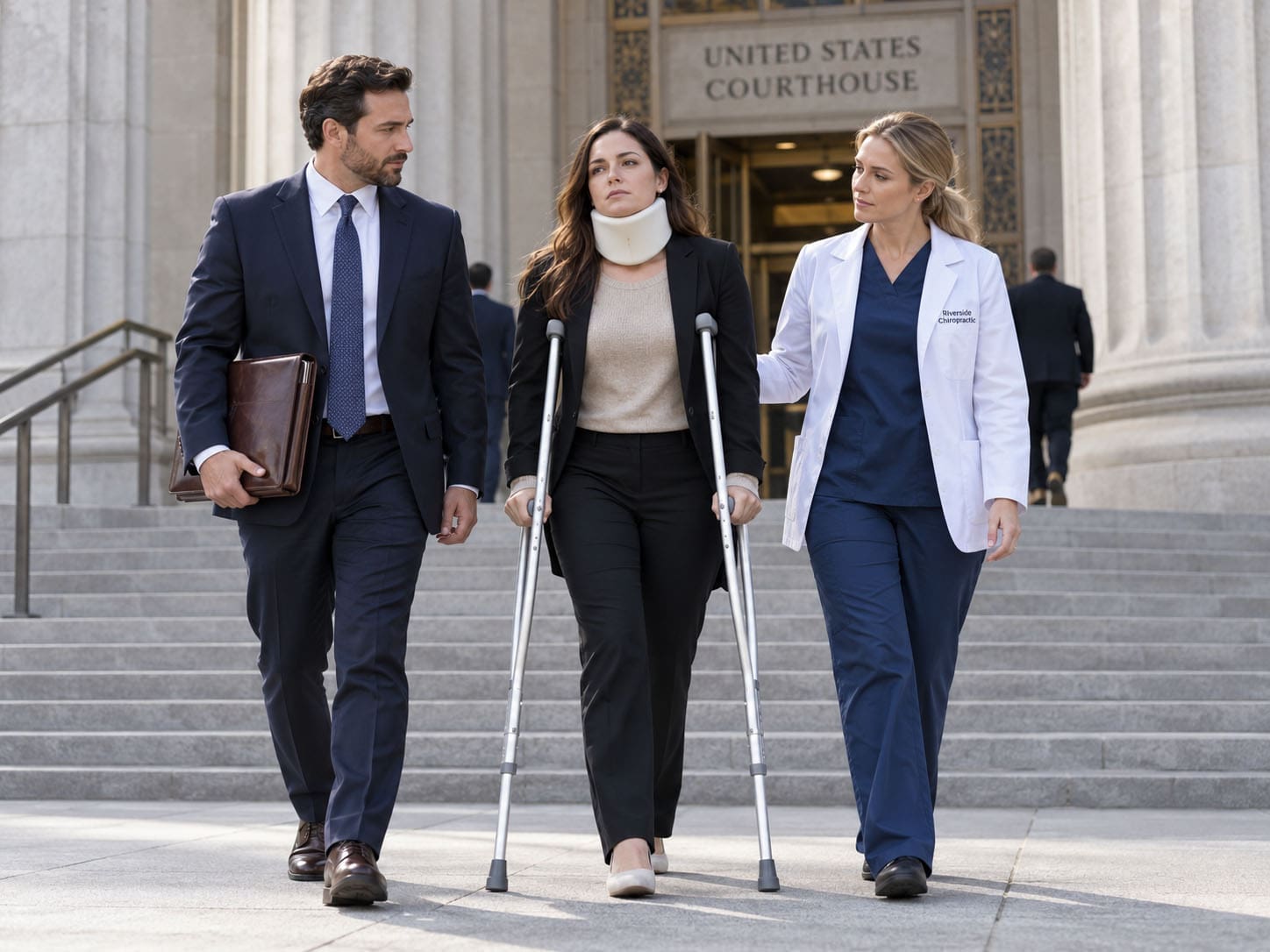
One Accident, Multiple Medical Appointments: Why Coordinated Records Matter for Family Recovery
Abstract
After an accident, a patient’s medical story rarely lives in one chart. Emergency department records may describe the first symptoms. A primary care appointment may document how those symptoms changed. A chiropractic assessment may identify movement restrictions, neurologic findings, and musculoskeletal dysfunction. Imaging, specialist referrals, and rehabilitation notes may then show how the patient progressed—or failed to progress—over time. For El Paso personal injury attorneys, understanding how these separate records fit together can make a complicated medical file much easier to evaluate. For patients and families, coordinated information can also reduce confusion, improve continuity, and support informed healthcare decisions.

One Collision Can Create Several Medical Stories
Imagine a hypothetical El Paso mother named Elena.
On Monday afternoon, Elena is stopped at a traffic light when another vehicle strikes her car from behind. She immediately feels shaken and develops increasing neck stiffness and a headache. Because she is also responsible for picking up her children and managing her household, her first concern is not litigation. It is getting home safely.
That evening, worsening symptoms bring her to an emergency department.
Three days later, she sees her primary care provider.
The following week, persistent neck and shoulder symptoms lead to a musculoskeletal and chiropractic evaluation. She is later referred for imaging and begins a structured rehabilitation program.
There is only one accident, but Elena now has medical information spread among several healthcare settings.
That is where coordinated records become important.
The Agency for Healthcare Research and Quality describes care coordination as deliberately organizing patient care and sharing relevant information among the people involved so that care is safer and more effective. Transitions between hospitals, primary care practices, specialists, and rehabilitation providers are especially important because responsibility and information move from one setting to another (Agency for Healthcare Research and Quality [AHRQ], n.d.).
For a personal injury attorney, that same coordination can help reveal a clearer clinical chronology.
The Parent’s Perspective: “Why Do I Have to Tell This Story Again?”
From Elena’s perspective, every appointment feels like another retelling of the collision.
At the emergency department, she explains when the crash occurred, where she was seated, whether she struck anything inside the vehicle, and what symptoms appeared afterward.
At primary care, she repeats much of the story but adds new information: she is sleeping poorly, turning her head while driving is difficult, and lifting groceries increases her shoulder pain.
At rehabilitation, the story becomes more functional. Can she turn her neck? Can she tolerate sitting? Can she lift? Can she perform household work? Has she returned to normal exercise? Can she complete her job without symptoms?
These details are not interchangeable.
Each visit captures Elena at a different point in recovery.
A 2026 review of continuity across healthcare transitions emphasized three related forms of continuity: informational, management, and relational. Breakdowns in information transfer and uncertainty about who handles follow-up can contribute to fragmented care (Markovich et al., 2026).
For the patient, better information transfer means fewer gaps and less unnecessary repetition.
For counsel, it can produce something equally valuable: a more understandable timeline.
The Emergency Department: The Beginning of the Clinical Timeline
Emergency department records often provide some of the earliest contemporaneous documentation after a collision.
These records may include:
- Date and approximate time of presentation
- Patient-reported mechanism of injury
- Initial areas of pain or discomfort
- Neurological complaints
- Physical examination findings
- Imaging performed to evaluate urgent concerns
- Medications administered or prescribed
- Discharge instructions
- Recommendations for follow-up
Interpret these records within their intended purpose.
The emergency department’s primary responsibility is to identify and manage urgent or potentially dangerous conditions. An emergency evaluation that does not identify a fracture, internal injury, or neurological emergency does not necessarily establish that no musculoskeletal or soft-tissue injury exists.
That distinction can matter when attorneys review a later chiropractic, primary-care, or rehabilitation record.
The question should not simply be, “Did the emergency department find something?”
A better question is:
What was the emergency department evaluating, what did it document, and what happened clinically afterward?
The Primary Care Perspective: Connecting the Accident to the Whole Patient
Several days later, Elena sees her primary care provider.
This visit provides a different perspective because primary care may know what Elena’s health looked like before the accident.
Perhaps the chart documents that she had occasional headaches but no previous radiating arm symptoms. Maybe she had controlled hypertension, a medication allergy, or an older episode of lower back discomfort that resolved years earlier.
Those details matter clinically.
They also help prevent the patient’s medical history from being oversimplified.
A well-coordinated primary care record can help distinguish among:
- Pre-existing medical conditions
- Prior musculoskeletal complaints
- New symptoms reported after the accident
- Aggravation of an existing condition
- Medication considerations
- New functional limitations
- Symptoms requiring specialist referral
For attorneys evaluating medical evidence, pre-existing findings should not automatically be ignored or automatically blamed for everything that follows an accident.
Instead, the medical record should allow qualified clinicians to examine the patient’s baseline, mechanism of injury, subsequent symptoms, objective findings, and clinical course.
A complete timeline does not prove medical causation on its own. It gives clinicians and legal professionals better information with which to evaluate causation.
The Chiropractic and Musculoskeletal Assessment: Looking at Function
When Elena’s symptoms continue, her evaluation moves beyond urgent screening.
A chiropractic or musculoskeletal examination may assess cervical and lumbar range of motion, joint function, muscular guarding, orthopedic findings, sensory changes, strength, reflexes, balance, posture, and activities that provoke symptoms.
Dr. Alex Jimenez’s published information describes his dual role as a chiropractor and board-certified family nurse practitioner, with a particular focus on trauma-related neck, back, spinal, and soft-tissue conditions. His practice combines musculoskeletal evaluation with broader medical assessment and diagnostic coordination. Review Dr. Jimenez’s Board-Certified Nurse Practitioner profile
This portion of the record can be particularly useful when it documents measurable findings rather than simply repeating a pain score.
For example:
“Neck hurts” provides useful subjective information.
A record containing symptom distribution, measured range of motion, neurological examination findings, orthopedic testing, functional limitations, treatment response, and reevaluation findings provides substantially more clinical context.
The Rehabilitation Clinician’s Perspective: What Can Elena Actually Do?
Several weeks into recovery, another part of the story becomes increasingly important.
Function.
Elena tells her rehabilitation clinician:
“I can work longer than I could two weeks ago, but checking the blind spot while driving still hurts.”
That statement provides information that a diagnostic code alone cannot.
Rehabilitation documentation may track:
- Walking or standing tolerance
- Cervical and trunk mobility
- Strength
- Balance and coordination
- Lifting tolerance
- Sitting tolerance
- Sleep disruption
- Work activities
- Household tasks
- Driving tolerance
- Exercise progression
- Home rehabilitation compliance
For a parent, these limitations may affect far more than employment. Recovery can influence childcare, transportation, grocery shopping, housework, sleep, exercise, and participation in family life.
That is why functional progress notes can become an important part of the overall injury story.
Separate Records Should Tell a Consistent—but Not Artificially Identical—Story
Good coordination does not mean every clinician writes the same note.
In fact, identical records would be neither necessary nor desirable.
The emergency physician, primary care provider, chiropractor, radiologist, and rehabilitation professional each have different clinical responsibilities.
What matters is whether the records can be reasonably reconciled.
An attorney reviewing Elena’s file might ask:
- Does the reported accident date remain consistent?
- Are the body regions involved reasonably consistent over time?
- Were additional symptoms documented as they appeared?
- Were meaningful pre-existing conditions identified rather than hidden?
- Do examination findings support the treatment being provided?
- Did you make referrals when symptoms warranted additional evaluation?
- Does rehabilitation documentation describe functional progress?
- Are changes in treatment explained?
This approach is stronger than searching for a single sentence that supposedly proves the entire case.
Patient Permission and Accurate Information-Sharing
Patients should understand who receives their healthcare information and why.
At the same time, it is important not to describe HIPAA as requiring a signed release every time two treating clinicians communicate.
Federal HIPAA rules generally allow covered healthcare providers to disclose protected health information to another healthcare provider for treatment without obtaining a separate patient authorization. That can include medical records, X-rays, laboratory results, diagnoses, and other information relevant to treatment. Reasonable privacy safeguards still apply.
Texas medical privacy guidance similarly recognizes exceptions for treatment and care coordination.
Different rules may apply when records are being sent outside the treatment relationship—for example, to an attorney or another third party. Appropriate authorizations should therefore be obtained when required, with the disclosure clearly identifying what information may be released and to whom.
Patients also generally have important rights to access their own medical information and request correction of inaccurate or incomplete information.
For an injury patient, this is part of autonomy: understanding the record and participating in decisions about care and appropriate disclosure.
Why Coordinated Records Matter to Personal Injury Attorneys
For legal teams, a medical file is easier to evaluate when it behaves like a timeline rather than a pile of unrelated documents.
The strongest chronology often connects:
accident → initial symptoms → examination → objective findings → treatment decisions → referrals → functional limitations → reevaluation → recovery or persistent impairment.
That sequence can help counsel assess whether the medical evidence is internally coherent.
It can also identify problems early.
An unexplained treatment gap may require context. A prior injury may require comparison. A new neurological complaint may require referral. Conflicting medication lists may need reconciliation. A major change in symptoms may deserve clinical explanation.
Coordination therefore benefits both sides of the medical-legal equation.
It supports safer healthcare while giving attorneys a more organized factual record to evaluate.
A Distinct Multidisciplinary Model in El Paso
Injury Medical Chiropractic and Functional Medicine Clinic in El Paso uses a medically integrated model led by Dr. Maria Guadalupe Cardenas, MD, a board-certified internal medicine physician who serves as Medical Director and Collaborative Physician, together with Dr. Alex Jimenez, DC, APRN, FNP-BC, CFMP, IFMCP, a dual-licensed chiropractor and board-certified family nurse practitioner whose practice emphasizes joint, spinal, and soft-tissue injury care. The clinic’s current published materials describe this as the only El Paso model combining dual-licensure soft-tissue expertise with full medical-director oversight for personal-injury causation work.
That structure allows medical oversight, musculoskeletal assessment, chiropractic care, rehabilitation, diagnostic coordination, and selected non-invasive therapies to be considered within a connected clinical environment rather than assembled from unrelated offices. The clinic’s multidisciplinary injury-care overview further describes coordinated nurse-practitioner evaluation, chiropractic examination, rehabilitation, imaging or diagnostic referral when indicated, and ongoing documentation. Explore El Paso multidisciplinary injury care
The benefit is not simply having several services available. The goal is beneficence through coordinated root-cause care, non-maleficence through appropriate conservative and non-invasive options when clinically suitable, and autonomy through patient education and informed decision-making.
Chiropractic care, rehabilitation, acupuncture, or electroacupuncture may be considered, when appropriate, to reduce pain, restore mobility, improve function, and support recovery while remaining coordinated with the patient’s existing medical team. Treatment should always depend on examination findings, indications, contraindications, patient preferences, and the broader clinical picture.
A Better Medical Story Starts With Better Coordination
Return to Elena.
Her emergency record alone does not tell the entire story.
Neither does her primary care note.
Neither does an X-ray, chiropractic examination, rehabilitation progress report, or final reevaluation.
The value emerges when qualified professionals can understand how those pieces relate.
The parent remembers what changed in everyday life.
The primary care provider understands the patient’s medical baseline.
The injury and rehabilitation clinicians measure how trauma affected movement and function—and how those findings evolve.
Together, those perspectives create something much more useful than a stack of appointments: a clinical timeline.
For El Paso attorneys evaluating personal injury evidence, coordinated records can help separate assumptions from documented facts. For families, the same coordination can reduce confusion and keep care focused on recovery rather than paperwork.
Attorneys or injured patients preparing for an injury evaluation can review the clinic’s personal injury intake process or its medical-causation evaluation resources for additional information.
References
Agency for Healthcare Research and Quality. (n.d.). Care coordination. U.S. Department of Health and Human Services.
Agency for Healthcare Research and Quality. (n.d.). What is care coordination? U.S. Department of Health and Human Services.
Markovich, L., Sela, Y., & Grinberg, K. (2026). Continuity of care across hospital-to-community transitions: A narrative review integrating concepts, measurement, and nursing-relevant approaches. Healthcare, 14(5), 656. https://doi.org/10.3390/healthcare14050656
U.S. Department of Health and Human Services. (n.d.). Does the HIPAA Privacy Rule permit doctors, nurses, and other health care providers to share patient health information for treatment purposes without the patient’s authorization?
U.S. Department of Health and Human Services. (n.d.). Your medical records.
Office of the Attorney General of Texas. (n.d.). Medical privacy.
Post Disclaimer
General Disclaimer, Licenses and Board Certifications *
Professional Scope of Practice *
The information herein on "One Accident, Multiple Medical Appointments: Why Coordinated Records Matter for Family Recovery" is not intended to replace a one-on-one relationship with a qualified health care professional or licensed physician and is not medical advice. We encourage you to make healthcare decisions based on your research and partnership with a qualified healthcare professional.
Blog Information & Scope Discussions
Welcome to El Paso's Premier Wellness and Injury Care Clinic & Wellness Blog, where Dr. Alex Jimenez, DC, FNP-C, a Multi-State board-certified Family Practice Nurse Practitioner (FNP-BC) and Chiropractor (DC), presents insights on how our multidisciplinary team is dedicated to holistic healing and personalized care. Our practice aligns with evidence-based treatment protocols inspired by integrative medicine principles, similar to those on this site and on our family practice-based chiromed.com site, focusing on naturally restoring health for patients of all ages.
Our areas of multidisciplinary practice include Wellness & Nutrition, Chronic Pain, Personal Injury, Auto Accident Care, Work Injuries, Back Injury, Low Back Pain, Neck Pain, Migraine Headaches, Sports Injuries, Severe Sciatica, Scoliosis, Complex Herniated Discs, Fibromyalgia, Chronic Pain, Complex Injuries, Stress Management, Functional Medicine Treatments, and in-scope care protocols.
Our information scope is multidisciplinary, focusing on musculoskeletal and physical medicine; wellness, contributing etiological viscerosomatic disturbances within clinical presentations, associated somato-visceral reflex clinical dynamics; subluxation complexes, sensitive health issues, and functional medicine articles, topics, and discussions.
We provide and facilitate clinical collaboration with specialists across disciplines. Each specialist is governed by their professional scope of practice and licensure jurisdiction. We use functional health & wellness protocols to treat and support care for musculoskeletal injuries or disorders.
Our videos, posts, topics, and insights address clinical matters and issues that directly or indirectly relate to our clinical scope of practice.
Our office has made a reasonable effort to provide supportive citations and has identified relevant research studies that support our posts. We provide copies of supporting research studies upon request to regulatory boards and the public.
We understand that we cover matters that require an additional explanation of how they may assist in a particular care plan or treatment protocol; therefore, to discuss the subject matter above further, please feel free to ask Dr. Alex Jimenez, DC, APRN, FNP-BC, or contact us at 915-850-0900.
We are here to help you and your family.
Blessings
Dr. Alex Jimenez DC, MSACP, APRN, FNP-BC*, CCST, IFMCP, CFMP, ATN
Email: [email protected]
Multidisciplinary Licensing & Board Certifications:
Licensed as a Doctor of Chiropractic (DC) in Texas & New Mexico*
Chiropractic Licenses:
Texas DC License #: TX5807, Verified: TX5807
New Mexico DC License #: NM-DC2182, Verified: NM-DC2182
Nurse Practitioner Licenses:
Texas APRN License #: 1191402, Verified: 1191402 *
New Mexico CNP License #: 90560, Verified 90560
Florida APRN License #: 11043890, Verified: APRN11043890 *
Colorado License #: C-APN.0105610-C-NP, Verified: C-APN.0105610-C-NP
New York License #: N25929, Verified N25929
Georgia APRN License #: GAA-NP005701
Multi-State Advanced Practice Registered Nurse (APRN*) Texas & Multi-States
Multi-state Compact APRN License by Endorsement (43 States)
Compact Status: Multi-State License: Authorized to Practice in 43 States*
Nursing Licensure Compact: Updated Here
DEA Registration: (Drug Enforcement Agency Registered)
All medical (MDs) and family practice providers (FNP-APRN) are registered and licensed to offer various levels of medication.
Verify Providers' DEA Registration Here
License Verification Link: Nursys License Verifier
* Prescriptive Authority Authorized (DEA Registered Providers). Call if Required
Board Certification:
ANCC FNP-BC: Board Certified Nurse Practitioner*
Education:
Graduate with Honors: ICHS: MSN-FNP (Family Nurse Practitioner Program)
Degree Granted. Master's in Family Practice, MSN Diploma (Cum Laude)
Dr. Alex Jimenez, DC, APRN, FNP-BC*, CFMP, IFMCP, ATN, CCST
(Board Certified: Family Practice Nurse Practitioner—Multistate)*
(Licensed Nurse Practitioner & Chiropractor - Multistate)*
Clinical Director
DC & FNP License (Review Above)
Digital Business Card
NPI: 1205907805
Dr. Maria Cardenas, MD
(Board Certified: Internal Medicine)
(Licensed Medical Doctor)
Medical Director, Clinical Director & Collaborative Physician
NPI # 1164426748
MD License #: J2933
Licenses and Board Certifications:
MD: Medical Doctor
DC: Doctor of Chiropractic
APRNP: Advanced Practice Registered Nurse
FNP-BC: Family Practice Specialization (Multi-State Board Certified)
FNP-BC: Family Practice Across Life Span (Neonatal to Geriatrics)
RN: Registered Nurse (Multi-State Compact License)
CFMP: Certified Functional Medicine Provider
MSN-FNP: Master of Science in Family Practice Medicine
MSACP: Master of Science in Advanced Clinical Practice
IFMCP: Institute of Functional Medicine
CCST: Certified Chiropractic Spinal Trauma
ATN: Advanced Translational Neutrogenomics
Family with Primary Care Focus (Family Nurse Practitioner or FNP)
- The Family Nurse Practitioner (FNP) promotes, maintains, and restores health for individuals and families across the lifespan. FNPs also identify health risks, promote wellness, and diagnose and manage acute and chronic illness.
- The FNP focuses on comprehensive primary care, promoting healthy lifestyles for patients across the lifespan in settings such as private practice, physician offices, and community health centers.
Memberships & Associations:
TCA: Texas Chiropractic Association: Member ID: 104311
TNA: Texas Nurse Association: Member ID: 06458222
TNP: Texas Nurse Practitioner Association ID: 2025091511
AANP: American Association of Nurse Practitioners: Member ID: 2198960
ANA: American Nurses Association: Member ID: 06458222 (District TX01)
| Primary Taxonomy | Selected Taxonomy | State | License Number |
|---|---|---|---|
| No | 111N00000X - Chiropractor | NM | DC2182 |
| Yes | 111N00000X - Chiropractor | TX | DC5807 |
| Yes | 363LF0000X - Nurse Practitioner - Family | TX | 1191402 |
| Yes | 363LF0000X - Nurse Practitioner - Family | FL | 11043890 |
| Yes | 363LF0000X - Nurse Practitioner - Family | CO | C-APN.0105610-C-NP |
| Yes | 363LF0000X - Nurse Practitioner - Family | NY | N25929 |
| Yes | 363LF0000X - Nurse Practitioner - Family | NM |
90560 |
| Yes | 363LF0000X - Nurse Practitioner - Family | GA | GAA-NP005701 |
Dr. Alex Jimenez, DC, APRN, FNP-BC*, CFMP, IFMCP, ATN, CCST
(Board Certified: Family Practice Nurse Practitioner—Multistate)*
(Primary Care Across Lifespan—Neonatal / Pediatric / Adult / Geriatrics)
(Licensed Nurse Practitioner & Chiropractor - Multistate)*
Clinical Director
Digital Business Card
NPI: 1205907805
Dr. Maria Cardenas, MD
(Board Certified: Internal Medicine)*
(Licensed Medical Doctor)*
Medical Director, Clinical Director & Collaborative Physician
NPI # 1164426748
MD License #: J2933
📆 Schedule Appointment: Schedule 24/7 (Click Here)