
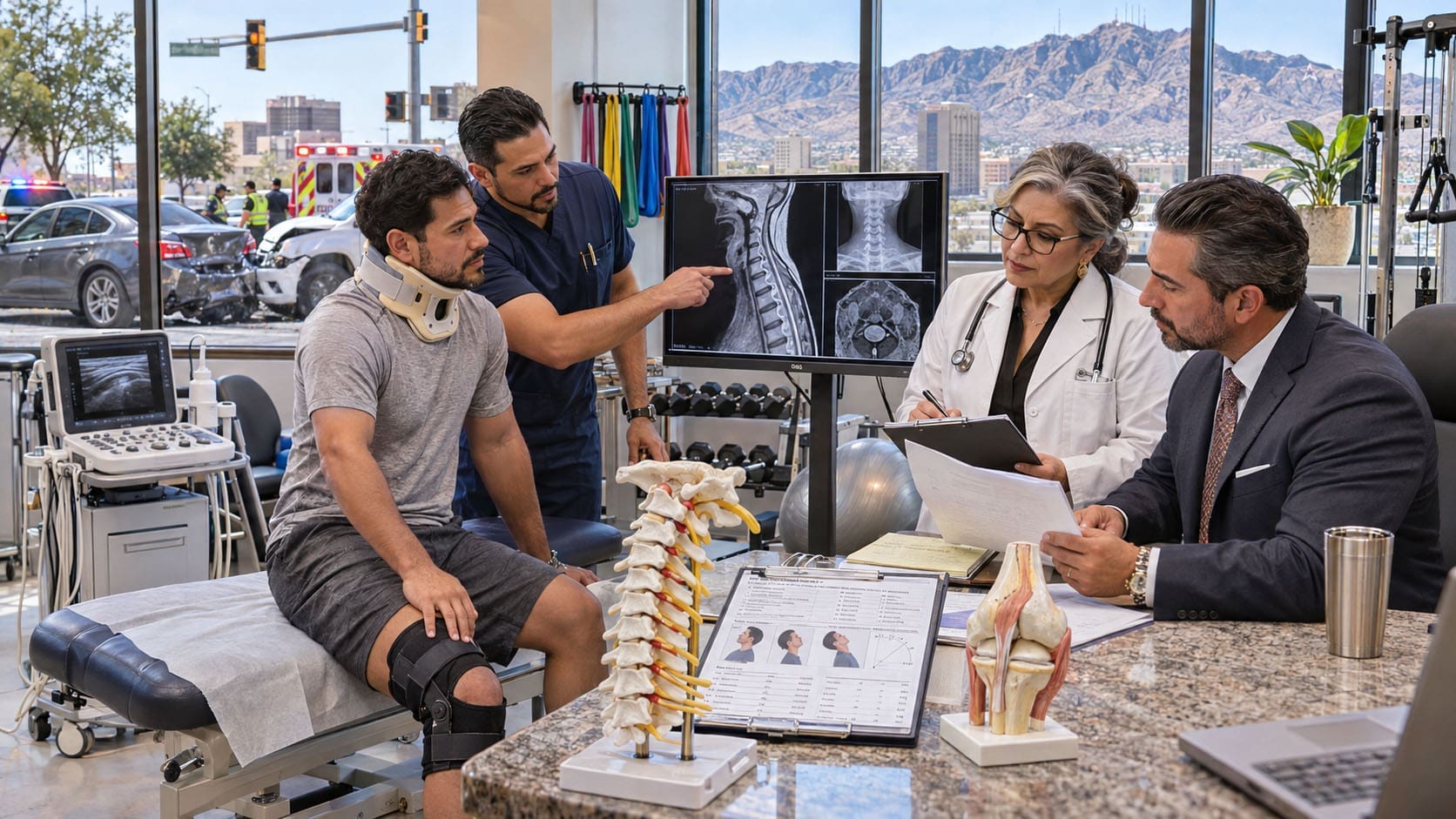
My Pain Improved After Treatment. Does That Mean the Accident Caused It?
Abstract
When pain improves after treatment following a car accident, that improvement is encouraging. It may show that the patient is recovering and that the treatment plan is helping restore movement, comfort, and daily function. However, improvement alone does not prove that the accident originally caused every symptom or medical finding. Establishing medical causation requires a broader investigation that considers the accident mechanism, prior medical history, symptom timing, physical examination findings, diagnostic testing, functional limitations, alternative explanations, and changes documented over time. This article follows a fictional parent recovering from a collision to explain how clinicians separate a positive treatment response from a medically supported causation opinion.

Maria Is Finally Feeling Better
Imagine Maria, a 42-year-old mother of two, stopped at a red light when another vehicle strikes her car from behind.
At first, she feels shaken but assumes she is fine. Later that evening, her neck becomes stiff. By the next morning, she has shoulder pain, difficulty turning her head, and a headache that makes it harder to concentrate at work.
Over the next few days, Maria notices something else: lifting groceries, driving her children to school, and sleeping comfortably have become harder.
She eventually undergoes a clinical evaluation. Her examination identifies restricted neck movement, muscle tenderness, and functional limitations. Her healthcare team begins an individualized conservative treatment program that may include chiropractic care, therapeutic exercise, rehabilitation, education, and other medically appropriate services.
Several weeks later, Maria feels substantially better.
Her headaches occur less often. She can turn her head more easily. She is sleeping better and has returned to many of her normal family activities.
Maria asks an understandable question:
“If treatment helped my pain, doesn’t that prove the accident caused it?”
The answer is: not by itself.
Her recovery matters, but medical causation requires clinicians to look at the entire clinical story.
Treatment Response and Medical Causation Answer Different Questions
A patient’s response to treatment can provide valuable clinical information.
For example, if restricted neck movement improves with rehabilitation and conservative musculoskeletal care, that improvement may support the healthcare team’s working diagnosis and treatment plan.
However, two different questions are being asked:
- Did the treatment help the patient’s condition?
- Did the accident cause or aggravate that condition?
Those questions are related, but they are not identical.
A patient may improve because of treatment, natural healing, temporary reduction in activity, medication, exercise, changes in sleep, rehabilitation, or a combination of factors.
Therefore, clinicians should not reason backward and say, “The treatment worked, so the accident must have caused everything.”
Instead, treatment response becomes one piece of evidence within a much larger causation analysis.
Dr. Jimenez’s discussion of accident injury medical causation in El Paso similarly emphasizes that causation conclusions should connect accident mechanics, medical history, symptom progression, examination findings, imaging, and reasonable alternative explanations.
Start With What Maria Was Like Before the Accident
One of the most important parts of Maria’s evaluation happened before anyone discussed treatment.
Her clinician asked about her previous health.
Questions might include:
- Did she already experience neck or back pain?
- Had she previously been involved in another accident?
- Did she have headaches before this collision?
- Was she receiving chiropractic, physical therapy, or medical treatment?
- Did she have arthritis, disc degeneration, neuropathy, or another condition?
- Could she work, exercise, drive, sleep, and care for her children normally before the crash?
- Had she recently experienced another injury?
This information does not exist to discredit the patient.
It helps establish a baseline.
Suppose Maria occasionally experienced mild neck stiffness before the collision but could work all day, exercise, drive without difficulty, and sleep normally. After the crash, she develops constant pain, headaches, markedly restricted movement, and difficulty performing normal activities.
That before-and-after comparison may be clinically important.
A pre-existing condition does not automatically mean an accident played no role. Trauma may produce a new injury, aggravate an existing disorder, or make a previously quiet condition symptomatic.
The medical question becomes:
What changed after the accident, and is that change reasonably consistent with the trauma that occurred?
The Accident Mechanism Adds Another Piece
Clinicians also consider how the collision occurred.
In Maria’s fictional case, she was stationary when another vehicle struck her from behind.
A rear impact can expose the neck and surrounding tissues to rapid acceleration and deceleration. Whiplash-associated disorders can involve muscles, joints, ligaments, neurological structures, and other cervical tissues.
However, the crash mechanism alone does not prove that Maria sustained a particular diagnosis.
Instead, it creates a biological and biomechanical hypothesis.
The clinician then asks whether Maria’s symptoms and examination findings fit that hypothesis.
For readers wanting a more detailed explanation, the clinic’s Texas Personal Injury Causation and Medical Evidence guide discusses why mechanism should be compared with symptom onset, examination findings, neurological findings, functional changes, and diagnostic evidence rather than treated as proof by itself.
Examination Findings Help Test the Story
Pain is real and clinically important, but pain intensity alone does not establish its cause.
A structured examination gives clinicians additional information.
Depending on Maria’s condition, an examination might assess:
- Cervical and shoulder range of motion
- Muscle tenderness and guarding
- Strength
- Reflexes
- Sensation
- Orthopedic testing
- Neurological findings
- Posture and movement
- Balance or gait
- Ability to perform functional activities
The clinician looks for patterns.
For example, does Maria’s restricted movement correspond with her areas of pain? Is weakness present? Are neurological symptoms developing? Are there findings suggesting cervical radiculopathy or another condition requiring further investigation?
These observations help the clinician develop and refine a differential diagnosis.
They also provide measurements to compare during future examinations.
Why Follow-Up Examinations Matter Even When Maria Feels Better
After several weeks, Maria reports that her pain has fallen substantially.
That is excellent news.
But her healthcare team still performs follow-up assessments.
Why?
Because pain is only one measure of recovery.
Clinical guidelines for neck pain recommend reassessment during care to determine whether the patient is recovering, requires additional treatment, has developed concerning findings, or is ready for discharge (Côté et al., 2016).
Maria may say her pain is almost gone while still demonstrating limited neck rotation or weakness. Conversely, she may still have some discomfort while showing major improvements in movement, strength, sleep, work tolerance, and activity.
Repeated examinations can document whether she is:
- Improving
- Remaining stable
- Reaching a plateau
- Developing new symptoms
- Returning toward her previous level of function
The clinic’s Defensible Medical Injury Documentation Best Practices page explains why repeated findings, treatment response, diagnostic reasoning, and changes in function contribute to a clearer longitudinal injury record.
What if Maria’s MRI Shows Degeneration?
Suppose Maria undergoes an MRI because neurological symptoms or other clinical findings justify further evaluation.
The report mentions degenerative disc changes.
Maria becomes worried.
“Does that mean the accident didn’t cause my pain?”
Not necessarily.
Degenerative spinal findings are common, including among people who do not have symptoms.
In a systematic review of 3,110 asymptomatic individuals, Brinjikji and colleagues found that degenerative imaging findings became increasingly common with age. The researchers emphasized that these findings must be interpreted within the patient’s overall clinical condition (Brinjikji et al., 2015).
An MRI therefore cannot usually answer the causation question by itself.
Maria’s clinician would need to consider her prior symptoms, previous medical records if available, examination findings, neurological findings, accident mechanism, functional changes, and symptom progression.
Some pre-existing findings may also affect recovery without necessarily explaining the entire post-accident clinical picture. Research on whiplash-associated disorders demonstrates why clinicians must evaluate different forms of cervical degeneration carefully rather than treating every degenerative finding as having the same significance (Malik et al., 2021).
Improvement Still Matters
None of this means Maria’s improvement is irrelevant.
Far from it.
Improvement is important because it helps clinicians evaluate whether the treatment plan remains appropriate.
Suppose Maria initially had:
- Pain rated 8 out of 10
- Severe limitation turning her neck
- Interrupted sleep
- Difficulty driving
- Reduced ability to work
- Trouble participating in family activities
Several weeks later, she reports:
- Pain of 2 out of 10
- Better neck movement
- Improved sleep
- Greater driving tolerance
- More consistent work attendance
- A return to normal family activities
That is meaningful clinical progress.
It can demonstrate a favorable recovery trajectory.
What clinicians should avoid is turning that observation into a claim the evidence cannot support, such as:
“Because treatment worked, the accident definitely caused every abnormality.”
A more careful conclusion considers the entire record.
Conservative Care Can Focus on Function, Not Just Pain
For appropriate neck pain and whiplash-associated conditions, multimodal conservative care may include combinations of education, movement, exercise, mobilization, manipulation, soft-tissue approaches, and other treatments selected according to the patient’s presentation.
Clinical guidelines support multimodal strategies for selected patients with neck pain and whiplash-associated disorders (Bussières et al., 2016).
The goal should extend beyond simply lowering the pain score.
For a parent like Maria, meaningful recovery may mean:
- Sleeping through the night
- Turning her head while driving
- Returning to work
- Exercising again
- Picking up groceries
- Playing with her children
- Regaining confidence in movement
Those improvements reflect patient-centered recovery.
They do not eliminate the need for accurate diagnosis or appropriate medical referral when symptoms suggest neurological or structural problems.
What Makes Injury Medical Chiropractic and Functional Medicine Clinic Different?
Injury Medical Chiropractic and Functional Medicine Clinic uses a coordinated model that brings musculoskeletal and medical perspectives into the same injury-care environment. Dr. Maria Guadalupe Cardenas, MD, serves as Medical Director and provides internal medicine oversight and coordination. The clinic also incorporates nurse-practitioner evaluation with an emphasis on medical assessment and soft-tissue injury, alongside chiropractic and rehabilitative care. Dr. Alex Jimenez, DC, APRN, FNP-BC, bridges chiropractic examination with advanced-practice medical evaluation, helping coordinate diagnostic testing, conservative treatment, rehabilitation, and referrals when clinically indicated.
This coordinated approach can be especially useful after an accident because patients may have overlapping musculoskeletal, neurological, medical, and functional concerns that need evaluation rather than treatment as isolated symptoms.
The Best Causation Opinion Does Not Start With the Desired Answer
A strong causation assessment does not begin by assuming the accident caused everything.
It begins with questions.
What happened?
What forces were involved?
When did the symptoms begin?
What was the patient’s health like beforehand?
What changed afterward?
Do the examination findings make anatomical sense?
Are there objective or reproducible findings?
Does imaging add useful information?
Are there reasonable alternative explanations?
How has the condition changed over time?
And what conclusions can the available evidence reasonably support?
Sometimes the evidence supports a new accident-related injury.
Sometimes it supports aggravation of a pre-existing condition.
Sometimes several factors contribute.
And occasionally the available evidence is not sufficient to confidently attribute a condition to the collision.
Acknowledging those possibilities makes a medical opinion more credible—not less.
Back to Maria
Several months after her collision, Maria’s pain has improved considerably.
She can drive comfortably again. She sleeps better. She is back to regular work and can participate in family activities she had temporarily stopped.
Her improvement tells her healthcare team something important:
She is recovering.
But the causation opinion comes from something larger.
It comes from the relationship between the collision, her pre-accident health, symptom onset, examination findings, any medically indicated diagnostic testing, treatment course, functional changes, and competing explanations.
Treatment response strengthens the clinical story when it fits that larger pattern.
It does not replace the story.
That distinction is important for patients, healthcare professionals, insurance reviewers, and attorneys alike.
Most importantly, it keeps the medical record focused where it belongs: on accurate diagnosis, informed patient choices, measurable recovery, appropriate coordination with the patient’s existing healthcare team, and conclusions that remain faithful to the clinical evidence.
References
Brinjikji, W., Luetmer, P. H., Comstock, B., Bresnahan, B. W., Chen, L. E., Deyo, R. A., Halabi, S., Turner, J. A., Avins, A. L., James, K., Wald, J. T., Kallmes, D. F., & Jarvik, J. G. (2015). Systematic literature review of imaging features of spinal degeneration in asymptomatic populations. American Journal of Neuroradiology, 36(4), 811–816. https://doi.org/10.3174/ajnr.A4173
Bussières, A. E., Stewart, G., Al-Zoubi, F., Decina, P., Descarreaux, M., Hayden, J., Hendrickson, B., Hincapié, C., Pagé, I., Passmore, S., Srbely, J., Stupar, M., Weisberg, J., & Ornelas, J. (2016). The treatment of neck pain-associated disorders and whiplash-associated disorders: A clinical practice guideline. Journal of Manipulative and Physiological Therapeutics, 39(8), 523–564.e27. https://doi.org/10.1016/j.jmpt.2016.08.007
Côté, P., Wong, J. J., Sutton, D., Shearer, H. M., Mior, S., Randhawa, K., Ameis, A., Carroll, L. J., Nordin, M., Yu, H., Lindsay, G. M., Southerst, D., Varatharajan, S., Jacobs, C., Stupar, M., Taylor-Vaisey, A., van der Velde, G., Gross, D. P., Brison, R. J., & Salhany, R. (2016). Management of neck pain and associated disorders: A clinical practice guideline from the Ontario Protocol for Traffic Injury Management Collaboration. European Spine Journal, 25(7), 2000–2022.
Malik, K., Eseonu, K. C., Pang, D., Fakouri, B., & Panchmatia, J. R. (2021). Is preexisting cervical degeneration a risk factor for poor prognosis in whiplash-associated disorder? International Journal of Spine Surgery, 15(4), 710–717. https://doi.org/10.14444/8093
This article is educational and does not replace individualized medical evaluation or legal advice. Assess accident-related causation using the complete clinical record and the facts of the individual case.
Post Disclaimer
General Disclaimer, Licenses and Board Certifications *
Professional Scope of Practice *
The information herein on "My Pain Improved After Treatment. Does That Mean the Accident Caused It?" is not intended to replace a one-on-one relationship with a qualified health care professional or licensed physician and is not medical advice. We encourage you to make healthcare decisions based on your research and partnership with a qualified healthcare professional.
Blog Information & Scope Discussions
Welcome to El Paso's Premier Wellness and Injury Care Clinic & Wellness Blog, where Dr. Alex Jimenez, DC, FNP-C, a Multi-State board-certified Family Practice Nurse Practitioner (FNP-BC) and Chiropractor (DC), presents insights on how our multidisciplinary team is dedicated to holistic healing and personalized care. Our practice aligns with evidence-based treatment protocols inspired by integrative medicine principles, similar to those on this site and on our family practice-based chiromed.com site, focusing on naturally restoring health for patients of all ages.
Our areas of multidisciplinary practice include Wellness & Nutrition, Chronic Pain, Personal Injury, Auto Accident Care, Work Injuries, Back Injury, Low Back Pain, Neck Pain, Migraine Headaches, Sports Injuries, Severe Sciatica, Scoliosis, Complex Herniated Discs, Fibromyalgia, Chronic Pain, Complex Injuries, Stress Management, Functional Medicine Treatments, and in-scope care protocols.
Our information scope is multidisciplinary, focusing on musculoskeletal and physical medicine; wellness, contributing etiological viscerosomatic disturbances within clinical presentations, associated somato-visceral reflex clinical dynamics; subluxation complexes, sensitive health issues, and functional medicine articles, topics, and discussions.
We provide and facilitate clinical collaboration with specialists across disciplines. Each specialist is governed by their professional scope of practice and licensure jurisdiction. We use functional health & wellness protocols to treat and support care for musculoskeletal injuries or disorders.
Our videos, posts, topics, and insights address clinical matters and issues that directly or indirectly relate to our clinical scope of practice.
Our office has made a reasonable effort to provide supportive citations and has identified relevant research studies that support our posts. We provide copies of supporting research studies upon request to regulatory boards and the public.
We understand that we cover matters that require an additional explanation of how they may assist in a particular care plan or treatment protocol; therefore, to discuss the subject matter above further, please feel free to ask Dr. Alex Jimenez, DC, APRN, FNP-BC, or contact us at 915-850-0900.
We are here to help you and your family.
Blessings
Dr. Alex Jimenez DC, MSACP, APRN, FNP-BC*, CCST, IFMCP, CFMP, ATN
Email: [email protected]
Multidisciplinary Licensing & Board Certifications:
Licensed as a Doctor of Chiropractic (DC) in Texas & New Mexico*
Chiropractic Licenses:
Texas DC License #: TX5807, Verified: TX5807
New Mexico DC License #: NM-DC2182, Verified: NM-DC2182
Nurse Practitioner Licenses:
Texas APRN License #: 1191402, Verified: 1191402 *
New Mexico CNP License #: 90560, Verified 90560
Florida APRN License #: 11043890, Verified: APRN11043890 *
Colorado License #: C-APN.0105610-C-NP, Verified: C-APN.0105610-C-NP
New York License #: N25929, Verified N25929
Georgia APRN License #: GAA-NP005701
Multi-State Advanced Practice Registered Nurse (APRN*) Texas & Multi-States
Multi-state Compact APRN License by Endorsement (43 States)
Compact Status: Multi-State License: Authorized to Practice in 43 States*
Nursing Licensure Compact: Updated Here
DEA Registration: (Drug Enforcement Agency Registered)
All medical (MDs) and family practice providers (FNP-APRN) are registered and licensed to offer various levels of medication.
Verify Providers' DEA Registration Here
License Verification Link: Nursys License Verifier
* Prescriptive Authority Authorized (DEA Registered Providers). Call if Required
Board Certification:
ANCC FNP-BC: Board Certified Nurse Practitioner*
Education:
Graduate with Honors: ICHS: MSN-FNP (Family Nurse Practitioner Program)
Degree Granted. Master's in Family Practice, MSN Diploma (Cum Laude)
Dr. Alex Jimenez, DC, APRN, FNP-BC*, CFMP, IFMCP, ATN, CCST
(Board Certified: Family Practice Nurse Practitioner—Multistate)*
(Licensed Nurse Practitioner & Chiropractor - Multistate)*
Clinical Director
DC & FNP License (Review Above)
Digital Business Card
NPI: 1205907805
Dr. Maria Cardenas, MD
(Board Certified: Internal Medicine)
(Licensed Medical Doctor)
Medical Director, Clinical Director & Collaborative Physician
NPI # 1164426748
MD License #: J2933
Licenses and Board Certifications:
MD: Medical Doctor
DC: Doctor of Chiropractic
APRNP: Advanced Practice Registered Nurse
FNP-BC: Family Practice Specialization (Multi-State Board Certified)
FNP-BC: Family Practice Across Life Span (Neonatal to Geriatrics)
RN: Registered Nurse (Multi-State Compact License)
CFMP: Certified Functional Medicine Provider
MSN-FNP: Master of Science in Family Practice Medicine
MSACP: Master of Science in Advanced Clinical Practice
IFMCP: Institute of Functional Medicine
CCST: Certified Chiropractic Spinal Trauma
ATN: Advanced Translational Neutrogenomics
Family with Primary Care Focus (Family Nurse Practitioner or FNP)
- The Family Nurse Practitioner (FNP) promotes, maintains, and restores health for individuals and families across the lifespan. FNPs also identify health risks, promote wellness, and diagnose and manage acute and chronic illness.
- The FNP focuses on comprehensive primary care, promoting healthy lifestyles for patients across the lifespan in settings such as private practice, physician offices, and community health centers.
Memberships & Associations:
TCA: Texas Chiropractic Association: Member ID: 104311
TNA: Texas Nurse Association: Member ID: 06458222
TNP: Texas Nurse Practitioner Association ID: 2025091511
AANP: American Association of Nurse Practitioners: Member ID: 2198960
ANA: American Nurses Association: Member ID: 06458222 (District TX01)
| Primary Taxonomy | Selected Taxonomy | State | License Number |
|---|---|---|---|
| No | 111N00000X - Chiropractor | NM | DC2182 |
| Yes | 111N00000X - Chiropractor | TX | DC5807 |
| Yes | 363LF0000X - Nurse Practitioner - Family | TX | 1191402 |
| Yes | 363LF0000X - Nurse Practitioner - Family | FL | 11043890 |
| Yes | 363LF0000X - Nurse Practitioner - Family | CO | C-APN.0105610-C-NP |
| Yes | 363LF0000X - Nurse Practitioner - Family | NY | N25929 |
| Yes | 363LF0000X - Nurse Practitioner - Family | NM |
90560 |
| Yes | 363LF0000X - Nurse Practitioner - Family | GA | GAA-NP005701 |
Dr. Alex Jimenez, DC, APRN, FNP-BC*, CFMP, IFMCP, ATN, CCST
(Board Certified: Family Practice Nurse Practitioner—Multistate)*
(Primary Care Across Lifespan—Neonatal / Pediatric / Adult / Geriatrics)
(Licensed Nurse Practitioner & Chiropractor - Multistate)*
Clinical Director
Digital Business Card
NPI: 1205907805
Dr. Maria Cardenas, MD
(Board Certified: Internal Medicine)*
(Licensed Medical Doctor)*
Medical Director, Clinical Director & Collaborative Physician
NPI # 1164426748
MD License #: J2933
📆 Schedule Appointment: Schedule 24/7 (Click Here)