
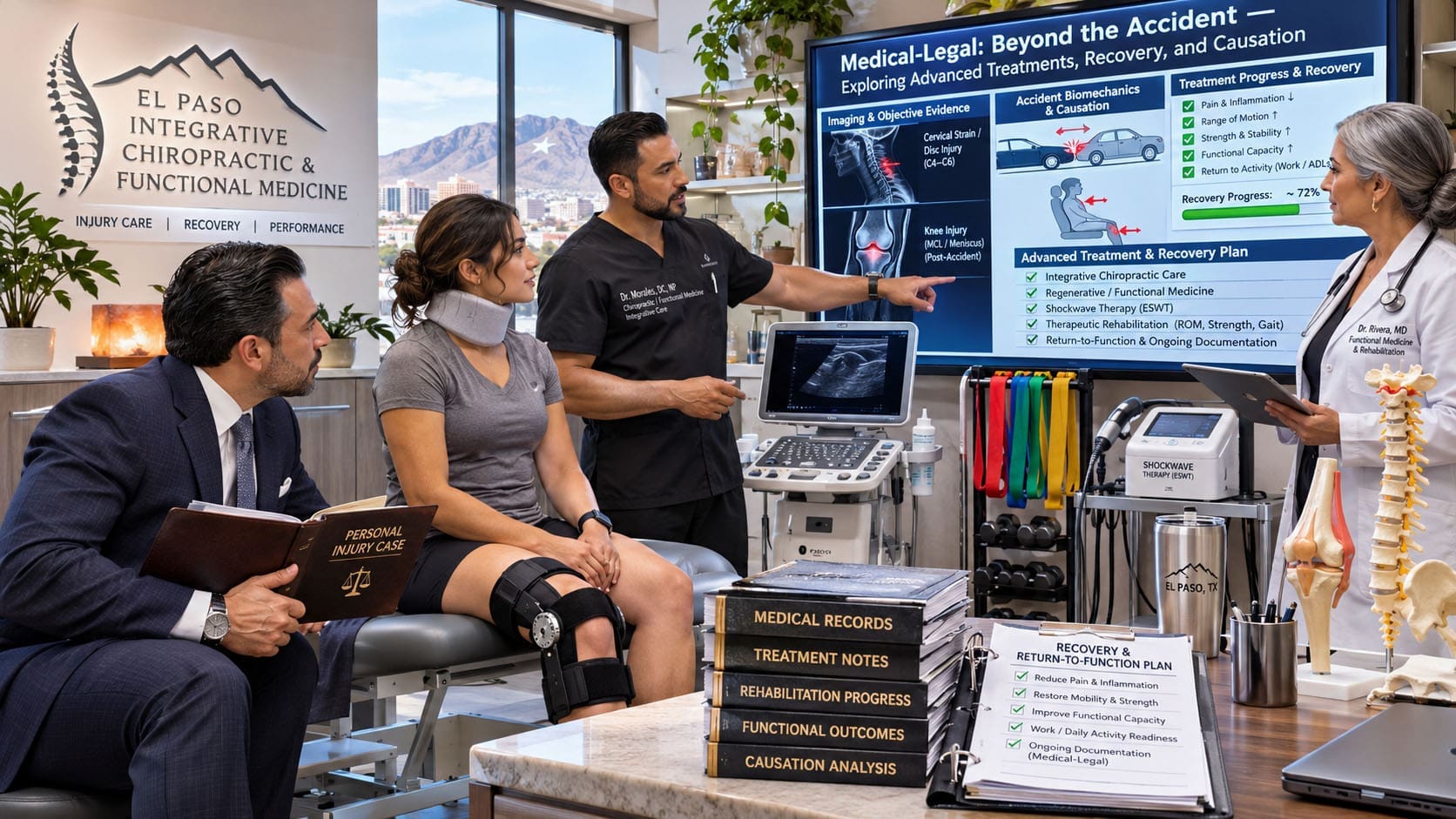
From Car Accident to Advanced Treatment: What Families Should Know Before Choosing an Injection Therapy
Abstract
After a car accident, most families expect treatment to begin with examination, imaging when appropriate, pain management, chiropractic care, and rehabilitation. But what happens when a shoulder, knee, hip, tendon, or other injured area still hurts weeks or months later? A clinician may begin discussing an injection procedure.

That conversation can be confusing. A corticosteroid injection, platelet-rich plasma (PRP), and an orthobiologic procedure such as microfragmented adipose tissue (MFAT) are very different treatments. They have different goals, risks, costs, recovery expectations, and levels of scientific evidence.
The important question is not simply, “Which injection is best?” It is, “What exactly has been diagnosed, why is this procedure being recommended, what evidence supports it for this condition, and what alternatives do I have?”
For families recovering after an accident, understanding those questions helps protect something just as important as physical recovery: the patient’s ability to make an informed decision.
When Pain Continues After the Accident
Imagine that a family member was injured in a car crash three months ago. The initial bruising has improved. They have completed several weeks of conservative treatment. Their neck moves better, and their general soreness has decreased.
But the shoulder still hurts every time they reach overhead.
Or perhaps the knee remains swollen after walking.
Maybe a tendon strained during the collision still hurts despite activity modification and rehabilitation.
Persistent symptoms do not automatically mean that an injection is necessary. They do mean that the condition may deserve another careful evaluation.
Before moving toward an advanced procedure, clinicians need to determine what tissue is actually producing the symptoms. Joint inflammation, osteoarthritis, bursitis, tendinopathy, a partial tendon tear, cartilage damage, ligament injury, nerve irritation, and referred pain can sometimes feel similar to the patient but require very different treatment strategies.
Current injection guidelines emphasize the importance of identifying the actual pain generator before choosing an injection target (Benzon et al., 2026). Image guidance, particularly ultrasound, may also improve the accuracy of certain injections.
That is why the diagnosis should come before the procedure.
An Injection Should Be Part of a Treatment Plan, Not the Diagnosis
A common mistake is starting with the procedure.
“I have shoulder pain, so should I get PRP?”
That question skips several steps.
A better sequence is:
What happened? What structure was injured? What does the examination show? What do imaging or diagnostic studies show? What treatment has already been attempted? What is limiting recovery now?
Only then should the discussion turn to whether an injection offers a reasonable next step.
For some patients, continued rehabilitation may be appropriate. Others may benefit from chiropractic care, therapeutic exercise, acupuncture or electroacupuncture, soft-tissue treatment, shockwave therapy, laser therapy, or another non-surgical approach. Some patients may need an orthopedic or neurological consultation instead.
And some may reasonably become candidates for an injection.
The goal is not to move a patient toward the most advanced treatment available. The goal is to match the treatment to the diagnosed problem.
Corticosteroid Injections: An Established Option for Selected Conditions
Corticosteroid injections have been used in musculoskeletal medicine for decades. Their primary purpose is to reduce inflammation and relieve symptoms.
Depending on the diagnosis, they may be used in joints, bursae, and other selected musculoskeletal structures.
Modern guidelines indicate that corticosteroid joint injections commonly provide short-term relief lasting several weeks to a few months, although results vary by condition and body region (Benzon et al., 2026).
That temporary pain reduction can sometimes serve an important purpose. If pain has prevented a patient from moving normally or participating in rehabilitation, decreasing inflammation may make exercise and functional recovery easier.
However, “more injections” does not automatically mean “better treatment.”
Corticosteroids can temporarily increase blood glucose and may affect cartilage, bone, adrenal function, and infection risk. Repeated injections into or around certain tendons also deserve caution. The 2025 American Academy of Orthopaedic Surgeons guideline, for example, notes concern that multiple steroid injections may compromise rotator-cuff integrity and potentially affect later repair (American Academy of Orthopaedic Surgeons [AAOS], 2025).
So corticosteroid therapy should be individualized rather than automatically repeated.
PRP: Using the Patient’s Own Platelets
Platelet-rich plasma differs significantly from a corticosteroid.
PRP begins with the patient’s own blood. The blood is processed to produce plasma containing a concentrated amount of platelets and signaling molecules. The provider then injects the preparation into the selected joint or soft-tissue area.
Rather than primarily suppressing inflammation, PRP is intended to influence the biological environment involved in tissue repair.
Research has become increasingly encouraging for some conditions, but PRP should not be described as a universal treatment.
A 2026 systematic review of randomized clinical trials found that PRP produced greater improvement in pain and function than hyaluronic-acid injections for knee osteoarthritis, although results varied substantially between studies and the certainty of evidence differed by outcome (Abduljabbar et al., 2026).
That does not mean the same results can automatically be expected in every tendon, ligament, joint, or post-accident injury.
The shoulder provides an excellent example. The AAOS’s 2025 rotator-cuff guideline states that routine PRP use is not supported for rotator-cuff tendinopathy or partial-thickness tears.
The lesson for families is important:
Evidence for PRP is diagnosis-specific.
A treatment can have reasonable evidence for one condition while remaining uncertain or unsupported for another.
Patients wanting a deeper explanation of the procedure can review Dr. Jimenez’s discussion of advanced PRP science and clinical considerations.
What About PRF, PFP, MFAT, and Other Orthobiologic Procedures?
Orthobiologics is a broad term for biologically derived materials used to support the body’s healing environment.
Depending on the clinical setting, patients may hear terms including platelet-rich fibrin (PRF), platelet-derived preparations, protein concentrates, or microfragmented adipose tissue.
MFAT, for example, uses a small amount of the patient’s own adipose tissue. Clinicians collect the tissue and mechanically process it before placing it in the selected treatment area.
Research into these therapies continues to develop. Some patients report improvements in pain and function, particularly in certain joint conditions, but preparation techniques, patient selection, study quality, and clinical protocols vary.
Dr. Jimenez discusses this distinction in When MFAT Is Recommended After Injuries, emphasizing that MFAT should not be presented as a guaranteed way to regenerate cartilage or cure arthritis.
That distinction is essential.
“Regenerative” does not mean “proven to regenerate every damaged structure.”
The U.S. Food and Drug Administration has also warned consumers about unapproved regenerative medicine products being marketed for orthopedic and other conditions. Patients considering cell- or tissue-based procedures should ask exactly what material is being used, how it is processed, what evidence supports that specific application, and what regulatory requirements apply (U.S. Food and Drug Administration [FDA], 2021).
Seven Questions Families Should Ask Before Saying Yes
An informed-consent conversation should give the patient enough information to decide whether a procedure fits their needs, values, finances, and recovery goals.
Before an injection, consider asking:
- What is my exact diagnosis? Ask what structure is believed to be causing the symptoms and how that conclusion was reached.
- Why are you recommending this injection now? Understand why the procedure is being considered instead of continued rehabilitation or another treatment.
- How strong is the evidence for my particular condition? Evidence from knee osteoarthritis cannot automatically be applied to a shoulder tendon, spinal problem, or ligament injury.
- What are my alternatives? These may include observation, activity modification, chiropractic care, rehabilitation, therapeutic exercise, acupuncture, electroacupuncture, medication, shockwave therapy, laser therapy, another specialist consultation, or surgery.
- What are the risks and realistic benefits? Ask about infection, bleeding, temporary soreness, medication-related effects, procedural complications, and the possibility that treatment may not help.
- What will it cost? Insurance coverage differs substantially. Some orthobiologic treatments may involve significant out-of-pocket expenses.
- What happens afterward? Ask about activity restrictions, rehabilitation, expected soreness, follow-up visits, and how success will be measured.
These questions are not signs that a patient distrusts the clinician. They are part of good healthcare.
Treatment Should Respect Patient Autonomy
A clinician may recommend an advanced procedure without making it mandatory.
That distinction matters.
A clinician can explain why an injection might help, describe the scientific evidence, discuss the alternatives, and offer professional guidance. The patient still makes the decision.
Some patients may prefer additional conservative treatment before moving forward. Others may decide that persistent limitations justify trying an injection. Another patient may want a second opinion.
All of these can be reasonable choices when the patient understands the options.
Respect for patient autonomy means giving people enough information to participate meaningfully in their own care, rather than pressuring them into a procedure.
Why Integrated Care Can Be Important After an Auto Injury
An injection usually addresses only one part of recovery.
Suppose PRP is performed for a selected knee condition. The biological treatment does not automatically correct reduced hip strength, an altered walking pattern, decreased balance, joint stiffness, or movement compensation that developed after the accident.
That is where integrated care becomes valuable.
Chiropractic and rehabilitative treatment can focus on mobility, joint mechanics, muscle control, strength, balance, and functional movement. Acupuncture or electroacupuncture may be considered for selected pain-management needs. Other non-invasive tools, including shockwave or photobiomodulation therapies, may be incorporated when clinically appropriate.
The goal is not to stack treatments simply because they are available.
It is to coordinate them around the patient’s diagnosis and measurable recovery goals.
Dr. Jimenez further explains this combined approach in his discussion of regenerative medicine and integrative chiropractic care.
What Makes Injury Medical Chiropractic and Functional Medicine Clinic Different?
Dr. Jimenez’s Injury Medical Chiropractic and Functional Medicine Clinic in El Paso uses a multidisciplinary model rather than approaching a complicated injury from only one clinical perspective.
Dr. Alex Jimenez, DC, APRN, FNP-BC, CFMP, IFMCP, bridges chiropractic physical medicine with advanced medical assessment as a board-certified family nurse practitioner. The clinic also has Dr. Maria Guadalupe Cardenas, MD, a board-certified internal medicine physician, serving as Medical Director and collaborative physician, along with nurse-practitioner expertise focused on soft-tissue and musculoskeletal injury.
This structure allows patients with persistent injuries to be evaluated from medical, chiropractic, rehabilitative, diagnostic, and functional perspectives before considering an advanced procedure.
The clinic is among a limited number of El Paso practices integrating services such as chiropractic rehabilitation, advanced medical evaluation, ultrasound-guided procedures, PRP/PRF-based treatments, MFAT, shockwave therapy, MLS laser therapy, acupuncture and electroacupuncture, and other selected non-surgical therapies within a coordinated clinical environment.
Patients can learn more about this multidisciplinary philosophy through Dr. Jimenez’s clinic and provider overview.
Advanced Treatment Does Not Automatically Mean Better Treatment
After a serious accident, families understandably want the treatment that offers the best opportunity for recovery.
But the most sophisticated procedure is not necessarily the right procedure.
For one patient, a corticosteroid injection may temporarily control inflammation enough to restart rehabilitation. Another may be an appropriate PRP candidate. Another may eventually be evaluated for an emerging orthobiologic option. Someone else may improve without an injection at all.
The decision begins with the diagnosis.
Then comes the evidence.
Then the alternatives, risks, costs, recovery expectations, and the patient’s goals.
When families understand those pieces, an injection stops being something mysterious that they have simply been “told to get.” It becomes one possible tool within a broader recovery plan—and the patient remains the informed decision-maker.
That is the foundation of responsible integrated care: use the least invasive reasonable options first, consider advanced treatment when the clinical findings justify it, explain uncertainty when research is still developing, and give patients the information they need to decide what is right for them.
References
Abduljabbar, F. H., Alshehri, D., Sharaf, R. M., Almokhtar, A. A., & Alamri, M. K. (2026). Platelet-rich plasma provides greater pain relief and functional improvement than hyaluronic acid for knee osteoarthritis: A systematic review and meta-analysis of randomized controlled trials. Journal of ISAKOS, 21, 101218. https://doi.org/10.1016/j.jisako.2026.101218
American Academy of Orthopaedic Surgeons. (2025). Management of rotator cuff injuries: Evidence-based clinical practice guideline. AAOS rotator cuff clinical practice guideline
Benzon, H. T., Provenzano, D. A., Nagpal, A., et al. (2026). Use and safety of corticosteroid injections in joints and musculoskeletal soft tissue: Guidelines from the American Society of Regional Anesthesia and Pain Medicine, the American Academy of Pain Medicine, the American Society of Interventional Pain Physicians, and the International Pain and Spine Intervention Society. Regional Anesthesia & Pain Medicine, 51(7), 746–773. https://doi.org/10.1136/rapm-2024-105656
U.S. Food and Drug Administration. (2021). Important patient and consumer information about regenerative medicine therapies. FDA regenerative medicine consumer information
Post Disclaimer
General Disclaimer, Licenses and Board Certifications *
Professional Scope of Practice *
The information herein on "From Car Accident to Advanced Treatment: What Families Should Know Before Choosing an Injection Therapy" is not intended to replace a one-on-one relationship with a qualified health care professional or licensed physician and is not medical advice. We encourage you to make healthcare decisions based on your research and partnership with a qualified healthcare professional.
Blog Information & Scope Discussions
Welcome to El Paso's Premier Wellness and Injury Care Clinic & Wellness Blog, where Dr. Alex Jimenez, DC, FNP-C, a Multi-State board-certified Family Practice Nurse Practitioner (FNP-BC) and Chiropractor (DC), presents insights on how our multidisciplinary team is dedicated to holistic healing and personalized care. Our practice aligns with evidence-based treatment protocols inspired by integrative medicine principles, similar to those on this site and on our family practice-based chiromed.com site, focusing on naturally restoring health for patients of all ages.
Our areas of multidisciplinary practice include Wellness & Nutrition, Chronic Pain, Personal Injury, Auto Accident Care, Work Injuries, Back Injury, Low Back Pain, Neck Pain, Migraine Headaches, Sports Injuries, Severe Sciatica, Scoliosis, Complex Herniated Discs, Fibromyalgia, Chronic Pain, Complex Injuries, Stress Management, Functional Medicine Treatments, and in-scope care protocols.
Our information scope is multidisciplinary, focusing on musculoskeletal and physical medicine; wellness, contributing etiological viscerosomatic disturbances within clinical presentations, associated somato-visceral reflex clinical dynamics; subluxation complexes, sensitive health issues, and functional medicine articles, topics, and discussions.
We provide and facilitate clinical collaboration with specialists across disciplines. Each specialist is governed by their professional scope of practice and licensure jurisdiction. We use functional health & wellness protocols to treat and support care for musculoskeletal injuries or disorders.
Our videos, posts, topics, and insights address clinical matters and issues that directly or indirectly relate to our clinical scope of practice.
Our office has made a reasonable effort to provide supportive citations and has identified relevant research studies that support our posts. We provide copies of supporting research studies upon request to regulatory boards and the public.
We understand that we cover matters that require an additional explanation of how they may assist in a particular care plan or treatment protocol; therefore, to discuss the subject matter above further, please feel free to ask Dr. Alex Jimenez, DC, APRN, FNP-BC, or contact us at 915-850-0900.
We are here to help you and your family.
Blessings
Dr. Alex Jimenez DC, MSACP, APRN, FNP-BC*, CCST, IFMCP, CFMP, ATN
Email: [email protected]
Multidisciplinary Licensing & Board Certifications:
Licensed as a Doctor of Chiropractic (DC) in Texas & New Mexico*
Chiropractic Licenses:
Texas DC License #: TX5807, Verified: TX5807
New Mexico DC License #: NM-DC2182, Verified: NM-DC2182
Nurse Practitioner Licenses:
Texas APRN License #: 1191402, Verified: 1191402 *
New Mexico CNP License #: 90560, Verified 90560
Florida APRN License #: 11043890, Verified: APRN11043890 *
Colorado License #: C-APN.0105610-C-NP, Verified: C-APN.0105610-C-NP
New York License #: N25929, Verified N25929
Georgia APRN License #: GAA-NP005701
Multi-State Advanced Practice Registered Nurse (APRN*) Texas & Multi-States
Multi-state Compact APRN License by Endorsement (43 States)
Compact Status: Multi-State License: Authorized to Practice in 43 States*
Nursing Licensure Compact: Updated Here
DEA Registration: (Drug Enforcement Agency Registered)
All medical (MDs) and family practice providers (FNP-APRN) are registered and licensed to offer various levels of medication.
Verify Providers' DEA Registration Here
License Verification Link: Nursys License Verifier
* Prescriptive Authority Authorized (DEA Registered Providers). Call if Required
Board Certification:
ANCC FNP-BC: Board Certified Nurse Practitioner*
Education:
Graduate with Honors: ICHS: MSN-FNP (Family Nurse Practitioner Program)
Degree Granted. Master's in Family Practice, MSN Diploma (Cum Laude)
Dr. Alex Jimenez, DC, APRN, FNP-BC*, CFMP, IFMCP, ATN, CCST
(Board Certified: Family Practice Nurse Practitioner—Multistate)*
(Licensed Nurse Practitioner & Chiropractor - Multistate)*
Clinical Director
DC & FNP License (Review Above)
Digital Business Card
NPI: 1205907805
Dr. Maria Cardenas, MD
(Board Certified: Internal Medicine)
(Licensed Medical Doctor)
Medical Director, Clinical Director & Collaborative Physician
NPI # 1164426748
MD License #: J2933
Licenses and Board Certifications:
MD: Medical Doctor
DC: Doctor of Chiropractic
APRNP: Advanced Practice Registered Nurse
FNP-BC: Family Practice Specialization (Multi-State Board Certified)
FNP-BC: Family Practice Across Life Span (Neonatal to Geriatrics)
RN: Registered Nurse (Multi-State Compact License)
CFMP: Certified Functional Medicine Provider
MSN-FNP: Master of Science in Family Practice Medicine
MSACP: Master of Science in Advanced Clinical Practice
IFMCP: Institute of Functional Medicine
CCST: Certified Chiropractic Spinal Trauma
ATN: Advanced Translational Neutrogenomics
Family with Primary Care Focus (Family Nurse Practitioner or FNP)
- The Family Nurse Practitioner (FNP) promotes, maintains, and restores health for individuals and families across the lifespan. FNPs also identify health risks, promote wellness, and diagnose and manage acute and chronic illness.
- The FNP focuses on comprehensive primary care, promoting healthy lifestyles for patients across the lifespan in settings such as private practice, physician offices, and community health centers.
Memberships & Associations:
TCA: Texas Chiropractic Association: Member ID: 104311
TNA: Texas Nurse Association: Member ID: 06458222
TNP: Texas Nurse Practitioner Association ID: 2025091511
AANP: American Association of Nurse Practitioners: Member ID: 2198960
ANA: American Nurses Association: Member ID: 06458222 (District TX01)
| Primary Taxonomy | Selected Taxonomy | State | License Number |
|---|---|---|---|
| No | 111N00000X - Chiropractor | NM | DC2182 |
| Yes | 111N00000X - Chiropractor | TX | DC5807 |
| Yes | 363LF0000X - Nurse Practitioner - Family | TX | 1191402 |
| Yes | 363LF0000X - Nurse Practitioner - Family | FL | 11043890 |
| Yes | 363LF0000X - Nurse Practitioner - Family | CO | C-APN.0105610-C-NP |
| Yes | 363LF0000X - Nurse Practitioner - Family | NY | N25929 |
| Yes | 363LF0000X - Nurse Practitioner - Family | NM |
90560 |
| Yes | 363LF0000X - Nurse Practitioner - Family | GA | GAA-NP005701 |
Dr. Alex Jimenez, DC, APRN, FNP-BC*, CFMP, IFMCP, ATN, CCST
(Board Certified: Family Practice Nurse Practitioner—Multistate)*
(Primary Care Across Lifespan—Neonatal / Pediatric / Adult / Geriatrics)
(Licensed Nurse Practitioner & Chiropractor - Multistate)*
Clinical Director
Digital Business Card
NPI: 1205907805
Dr. Maria Cardenas, MD
(Board Certified: Internal Medicine)*
(Licensed Medical Doctor)*
Medical Director, Clinical Director & Collaborative Physician
NPI # 1164426748
MD License #: J2933
📆 Schedule Appointment: Schedule 24/7 (Click Here)