

Photobiomodulation for Pain Relief and Recovery
Abstract
This educational article explores the profound cellular mechanisms behind Photobiomodulation Therapy (PBMT), often known as laser therapy, and its transformative potential in modern medicine. From a first-person perspective, I will guide you through the scientific journey of how light energy interacts with our cells to promote healing, reduce inflammation, and restore function. We will delve into the latest findings from leading researchers, explaining how PBMT activates mitochondria, modulates cytokine responses, and stimulates tissue regeneration across nerves and muscles. This post will also illuminate the synergistic relationship between PBMT and orthobiologics such as Platelet-Rich Plasma (PRP), demonstrating how combining these therapies can enhance clinical outcomes. Finally, I will explain how we integrate these advanced modalities at our clinic, where a multidisciplinary team approach, featuring integrative chiropractic care alongside medical oversight, provides a comprehensive and evidence-based path to recovery for our patients.
A Personal Journey into the Power of Light
After nearly a decade in this field, I feel like I’ve finally found my people. For years, mentioning the word “laser” in medical circles felt like an uphill battle. I faced skepticism and resistance—metaphorical rotten tomatoes and broken beer bottles for the first five years. Many of you in the regenerative medicine space can likely relate to that struggle. Pushing the boundaries of biologic-based therapies has been a similar journey. That’s why I am so thrilled to have the opportunity to share my experience and the powerful science that has not only vindicated this work but is now revolutionizing how we approach healing.
It all begins with a fundamental biological principle we often overlook: photosynthesis. The sun shines, plants grow, and they sustain life on our planet. We, as a species, have evolved over hundreds of thousands of years under that very sun. Our cells, down to their deepest genetic components, have developed a sensitivity to light.
Think about it this way: from our first days in medical school, we are taught that sunlight is essential for vitamin D synthesis. We accept this without question. Yet a significant gap exists in modern medical education regarding the broader therapeutic applications of light—a field known as Photobiomodulation Therapy (PBMT). This post is my effort to bridge that gap and explain how we can harness light to unlock the body’s innate ability to heal itself.
Our Integrative Approach at Injury Medical Clinic
At our practice, Injury Medical Clinic PA, we believe in a team-based, patient-centered model. My role as a Doctor of Chiropractic (DC) with advanced training as a Nurse Practitioner (APRN) and in Functional Medicine (CFMP, IFMCP) is to focus on the biomechanical, neurological, and metabolic aspects of health. I am privileged to work alongside Dr. Maria Guadalupe Cardenas, MD, a Board-Certified Internist with over 40 years of invaluable experience. Dr. Cardenas serves as our Medical Director and Collaborative Physician, providing essential medical oversight and ensuring our patients receive comprehensive, integrated care.
This multidisciplinary setup allows us to blend the best of different worlds:
- Chiropractic Care: We address musculoskeletal alignment, nerve function, and biomechanics to restore the body’s structural integrity.
- Medical Oversight: Dr. Cardenas provides the medical diagnosis, management, and direction necessary for complex cases, especially in personal injury and chronic disease.
- Functional Medicine: We investigate the root causes of dysfunction, considering genetics, lifestyle, and environmental factors to develop personalized treatment plans.
- Advanced Therapies: We incorporate cutting-edge modalities like Photobiomodulation (PBMT) and orthobiologics to accelerate healing at the cellular level.
This collaborative environment ensures that when we recommend a therapy like PBMT, it is part of a holistic strategy designed to treat the whole person, not just the symptom.
What is Photobiomodulation? Understanding the Language of Our Cells
Let’s break down the term:
- Photo: Light
- Bio: Life
- Modulation: To affect or change
Photobiomodulation is the process of using light to create a biological change. We know that light is energy, and its fundamental units are photons. Think of photons as the currency of light energy. When these photons penetrate our tissues, they transfer their energy to our cells, initiating a cascade of biological responses.
For the first twenty years of my practice, I was a mechanic, using tools to “fix” conditions. For the last ten, I have become more of a biologist, focused on creating the right environment for the body’s own cells to orchestrate a healing response. Cellular recovery is the goal, and this is where PBMT truly shines.
The Cellular Mechanisms: From Mitochondria to Tissue Repair
Everyone is talking about mitochondrial health and ATP production, but the effects of PBMT go much deeper. Let’s explore the documented cellular reactions that translate into the clinical outcomes we see every day—less pain in the shoulder, knee, or elbow.
1. Mitochondrial Activation and Energy Production
The primary target of PBMT within our cells is an enzyme in the mitochondria called cytochrome C oxidase. This enzyme is a photoacceptor, meaning it is specifically designed to absorb light. When photons of the correct wavelength strike this enzyme, it becomes more active. This supercharges the Krebs cycle, leading to several critical downstream effects:
- Increased ATP Production: The cell’s energy currency is produced in greater abundance, providing the fuel needed for repair and function.
- Modulation of Reactive Oxygen Species (ROS): While high levels of ROS cause oxidative stress, a transient, controlled increase acts as a crucial signaling molecule.
- Release of Nitric Oxide: Light can displace nitric oxide bound to cytochrome c oxidase, allowing oxygen to bind more efficiently and increasing cellular respiration. The released nitric oxide then acts as a vasodilator, improving local blood flow.
This initial spark in the mitochondria triggers a cascade that sends messages all the way to the cell’s nucleus, initiating gene transcription. This is how the cell starts producing the proteins and signaling molecules—cytokines—that direct the healing process.
2. Immune Modulation: Shifting from Inflammation to Repair
When you sustain an injury, your body floods the area with pro-inflammatory cytokines to kickstart the healing process. However, in chronic conditions, this inflammatory state can become “stalled,” preventing true recovery. PBMT helps modulate this immune response.
We can scientifically document that PBMT, using the right wavelength and dose, can:
- Increase anti-inflammatory cytokines, such as interleukin-10 (IL-10).
- Reduce pro-inflammatory cytokines, such as interleukin-6 (IL-6).
Essentially, PBMT helps guide the body out of the persistent inflammatory phase and into the reparative, healing phase.
3. Enhancing Blood Flow and Nerve Regeneration
The benefits continue to cascade through the body’s systems:
- Angiogenesis: PBMT has been shown to stimulate angiogenesis by promoting the production of cytokines, including galectin-1. Improved microcirculation is fundamental for delivering oxygen and nutrients to damaged tissue and removing waste products.
- Neurogenesis: We can even see improvements at the neuronal level. Studies have demonstrated that PBMT can upregulate proteins like hnRNP K, which are involved in axonal growth and neuronal repair. This is why it’s so effective for nerve-related pain and injury recovery.
4. Accelerating Muscle and Connective Tissue Recovery
- Muscle Recovery: Using electron microscopy, researchers have confirmed that PBMT improves muscle cell development and increases myoglobin production, thereby enhancing oxygenation and speeding recovery after exertion or injury.
- Fibroblast Activation: Fibroblasts are the body’s master builders, responsible for producing collagen and forming the structural framework for tissue repair. PBMT provides the energy these cells need to activate and get to work, which is why it pairs so well with orthobiologics that send the initial “go” signal.
By targeting these fundamental cellular processes, PBMT doesn’t just treat conditions like tendonitis or arthritis; it also treats the dysfunctional cells within the pathological tissue. It changes the cellular environment to one that fosters healing. That’s why it has such a broad range of applications for anything that ends in “-itis.”
The Science of Light: Wavelength, Penetration, and the Therapeutic Window
Not all light is created equal. The electromagnetic spectrum ranges from deadly gamma rays with very short wavelengths to harmless radio waves with very long wavelengths. There is a specific “therapeutic window” for PBMT, typically between 600 nanometers (red light) and 1200 nanometers (near-infrared light).
Why is this range so important? It’s all about penetration. To be effective, photons must reach the target tissue. Three primary obstacles stand in their way: skin, blood (hemoglobin), and water. The wavelengths within the therapeutic window are most adept at bypassing these absorbers and penetrating deep into the body, where musculoskeletal injuries reside.
- Red light (around 600-700 nm) is excellent for superficial tissues. It penetrates only a few millimeters, making it great for skin conditions, but it won’t reach deep muscles or joints.
- Near-infrared light (around 800-1100 nm) penetrates much deeper, making it the workhorse for orthopedic and musculoskeletal conditions.
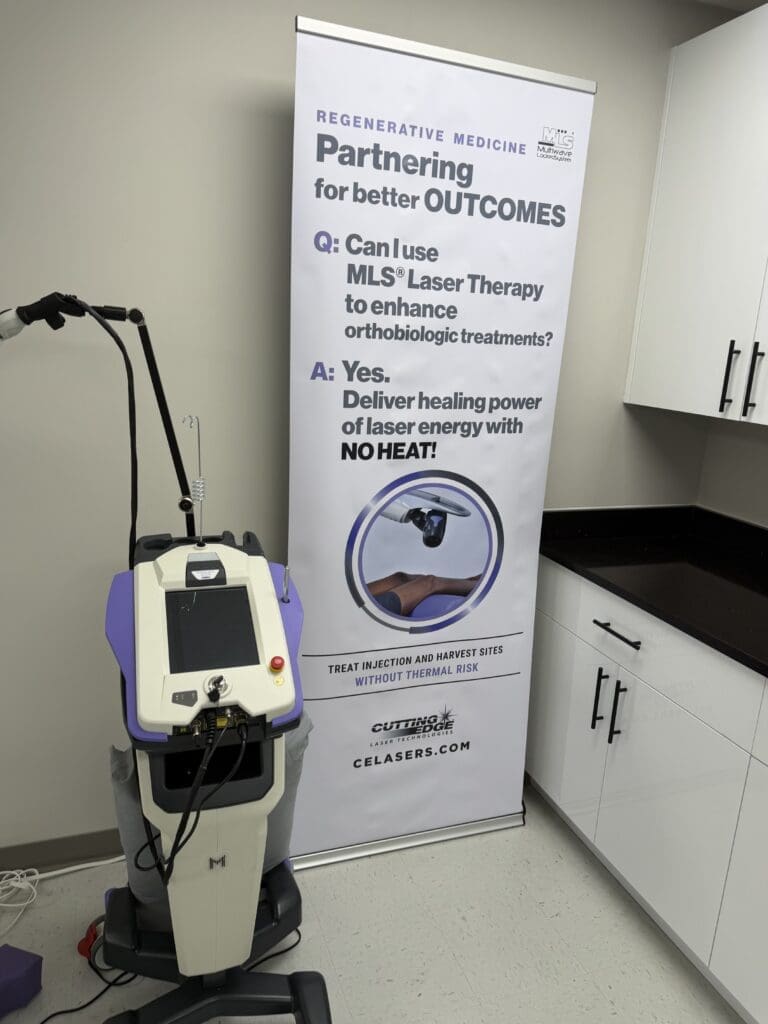
At our clinic, we use advanced systems like MLS (Multiwave Locked System) Laser Technology. I am a huge fan of this technology because it synchronizes two different wavelengths—one continuous and one pulsed. The pulsed wavelength, which fires thousands of times per second, allows the tissue to absorb light energy without building up excessive heat. This makes the treatment incredibly safe and effective, allowing for unattended application without the risk of thermal damage.
The Clinical Applications: From Acute Injury to Chronic Pain
In my practice, which includes serving as a team physician for a Division I school, we use PBMT across a spectrum of conditions:
- Acute Injuries: For our athletes, PBMT is a go-to for sprains, strains, and contusions. It significantly reduces recovery time and gets them back on the field faster.
- Post-Operative Recovery: Surgery is, in essence, a controlled acute injury. We use PBMT postoperatively to reduce swelling, bruising, and pain, resulting in cleaner incisions and significantly improved patient-reported outcomes.
- Chronic Inflammatory Conditions: For issues such as a thickened Achilles tendon or degenerative joint disease, where the inflammatory process is stalled, PBMT can reignite the healing cascade.
The evidence is overwhelming. With over 7,000 published studies, PBMT is gaining recognition from major health organizations. The Centers for Disease Control (CDC) mentions “laser photobiomodulation” dozens of times in its revised opioid guidelines as a non-pharmacological option for acute, subacute, and chronic pain. The science is no longer theoretical; it’s a clinical reality.
The Ultimate Synergy: Combining PBMT with Orthobiologics
This is where the magic truly happens. Orthobiologics like Platelet-Rich Plasma (PRP) are rich in growth factors and anti-inflammatory proteins. They are a powerful message sent to the site of injury, instructing the local cells to begin the repair process.
Now, imagine giving those cells the fuel they need to carry out those instructions. That is what PBMT does.
- Orthobiologics provide the blueprint (the message).
- PBMT provides the energy (the fuel).
By combining these two therapies, we are creating the optimal environment for cellular activity, healing, and regeneration. People are starting to talk about this synergy. A landmark study in the veterinary world—where patients don’t have secondary gain or placebo effects—provided powerful proof (Ferreira et al., 2021). In this canine study on knee osteoarthritis, dogs were treated with PBMT alone, then PRP alone, and finally a combination of both. The results were clear: the combination therapy produced significantly better outcomes.
The Future is Biology: A Glimpse into Our Research
We are committed to contributing to this growing body of evidence. I’m incredibly proud to share a “proud dad moment.” My son, Zachary, recently completed a study at the Mass General Brigham Enable BioSkills Lab. We took human tenocytes (tendon cells) and applied our laser over them.
The results were astounding: we demonstrated a 20% dose-dependent increase in tenocyte proliferation from PBMT alone.
We are literally proving that we can make tendon cells multiply with light. Our next steps involve qPCR to analyze gene expression and ELISA to measure protein levels. This research helps us move from anecdotal success to hard, reproducible science. The future of orthopedics isn’t just metal and screws; it’s biology. It’s about working with the body, not just on it.
From modulating inflammation to fueling cellular engines, Photobiomodulation Therapy has proven itself to be a cornerstone of modern, integrative care. I’ve witnessed its power firsthand, and I am honored to share this knowledge with you. It has been a pleasure to take you on this journey into the science of light and healing.
References
- Ferreira, M. P., Tucholski, G. Z., Dória, R. G. S., de Oliveira, B. C., Pimpão, C. T., & De Nardi, A. B. (2021). Intra-articular injections of platelet-rich plasma and photobiomodulation therapy (904 nm) for the treatment of canine osteoarthritis: A double-blinded, randomized clinical trial. Research in Veterinary Science, 139, 270–279. https://doi.org/10.1016/j.rvsc.2021.07.027
- Jimenez, A. (n.d.). Clinical Observations. Retrieved from https://chiromed.com/ and https://www.linkedin.com/in/dralexjimenez/
Post Disclaimer
General Disclaimer, Licenses and Board Certifications *
Professional Scope of Practice *
The information herein on "Photobiomodulation for Pain Relief and Recovery" is not intended to replace a one-on-one relationship with a qualified health care professional or licensed physician and is not medical advice. We encourage you to make healthcare decisions based on your research and partnership with a qualified healthcare professional.
Blog Information & Scope Discussions
Welcome to El Paso's Premier Wellness and Injury Care Clinic & Wellness Blog, where Dr. Alex Jimenez, DC, FNP-C, a Multi-State board-certified Family Practice Nurse Practitioner (FNP-BC) and Chiropractor (DC), presents insights on how our multidisciplinary team is dedicated to holistic healing and personalized care. Our practice aligns with evidence-based treatment protocols inspired by integrative medicine principles, similar to those on this site and on our family practice-based chiromed.com site, focusing on naturally restoring health for patients of all ages.
Our areas of multidisciplinary practice include Wellness & Nutrition, Chronic Pain, Personal Injury, Auto Accident Care, Work Injuries, Back Injury, Low Back Pain, Neck Pain, Migraine Headaches, Sports Injuries, Severe Sciatica, Scoliosis, Complex Herniated Discs, Fibromyalgia, Chronic Pain, Complex Injuries, Stress Management, Functional Medicine Treatments, and in-scope care protocols.
Our information scope is multidisciplinary, focusing on musculoskeletal and physical medicine; wellness, contributing etiological viscerosomatic disturbances within clinical presentations, associated somato-visceral reflex clinical dynamics; subluxation complexes, sensitive health issues, and functional medicine articles, topics, and discussions.
We provide and facilitate clinical collaboration with specialists across disciplines. Each specialist is governed by their professional scope of practice and licensure jurisdiction. We use functional health & wellness protocols to treat and support care for musculoskeletal injuries or disorders.
Our videos, posts, topics, and insights address clinical matters and issues that directly or indirectly relate to our clinical scope of practice.
Our office has made a reasonable effort to provide supportive citations and has identified relevant research studies that support our posts. We provide copies of supporting research studies upon request to regulatory boards and the public.
We understand that we cover matters that require an additional explanation of how they may assist in a particular care plan or treatment protocol; therefore, to discuss the subject matter above further, please feel free to ask Dr. Alex Jimenez, DC, APRN, FNP-BC, or contact us at 915-850-0900.
We are here to help you and your family.
Blessings
Dr. Alex Jimenez DC, MSACP, APRN, FNP-BC*, CCST, IFMCP, CFMP, ATN
Email: [email protected]
Multidisciplinary Licensing & Board Certifications:
Licensed as a Doctor of Chiropractic (DC) in Texas & New Mexico*
Chiropractic Licenses:
Texas DC License #: TX5807, Verified: TX5807
New Mexico DC License #: NM-DC2182, Verified: NM-DC2182
Nurse Practitioner Licenses:
Texas APRN License #: 1191402, Verified: 1191402 *
New Mexico CNP License #: 90560, Verified 90560
Florida APRN License #: 11043890, Verified: APRN11043890 *
Colorado License #: C-APN.0105610-C-NP, Verified: C-APN.0105610-C-NP
New York License #: N25929, Verified N25929
Georgia APRN License #: GAA-NP005701
Multi-State Advanced Practice Registered Nurse (APRN*) Texas & Multi-States
Multi-state Compact APRN License by Endorsement (43 States)
Compact Status: Multi-State License: Authorized to Practice in 43 States*
Nursing Licensure Compact: Updated Here
DEA Registration: (Drug Enforcement Agency Registered)
All medical (MDs) and family practice providers (FNP-APRN) are registered and licensed to offer various levels of medication.
Verify Providers' DEA Registration Here
License Verification Link: Nursys License Verifier
* Prescriptive Authority Authorized (DEA Registered Providers). Call if Required
Board Certification:
ANCC FNP-BC: Board Certified Nurse Practitioner*
Education:
Graduate with Honors: ICHS: MSN-FNP (Family Nurse Practitioner Program)
Degree Granted. Master's in Family Practice, MSN Diploma (Cum Laude)
Dr. Alex Jimenez, DC, APRN, FNP-BC*, CFMP, IFMCP, ATN, CCST
(Board Certified: Family Practice Nurse Practitioner—Multistate)*
(Licensed Nurse Practitioner & Chiropractor - Multistate)*
Clinical Director
DC & FNP License (Review Above)
Digital Business Card
NPI: 1205907805
Dr. Maria Cardenas, MD
(Board Certified: Internal Medicine)
(Licensed Medical Doctor)
Medical Director, Clinical Director & Collaborative Physician
NPI # 1164426748
MD License #: J2933
Licenses and Board Certifications:
MD: Medical Doctor
DC: Doctor of Chiropractic
APRNP: Advanced Practice Registered Nurse
FNP-BC: Family Practice Specialization (Multi-State Board Certified)
FNP-BC: Family Practice Across Life Span (Neonatal to Geriatrics)
RN: Registered Nurse (Multi-State Compact License)
CFMP: Certified Functional Medicine Provider
MSN-FNP: Master of Science in Family Practice Medicine
MSACP: Master of Science in Advanced Clinical Practice
IFMCP: Institute of Functional Medicine
CCST: Certified Chiropractic Spinal Trauma
ATN: Advanced Translational Neutrogenomics
Family with Primary Care Focus (Family Nurse Practitioner or FNP)
- The Family Nurse Practitioner (FNP) promotes, maintains, and restores health for individuals and families across the lifespan. FNPs also identify health risks, promote wellness, and diagnose and manage acute and chronic illness.
- The FNP focuses on comprehensive primary care, promoting healthy lifestyles for patients across the lifespan in settings such as private practice, physician offices, and community health centers.
Memberships & Associations:
TCA: Texas Chiropractic Association: Member ID: 104311
TNA: Texas Nurse Association: Member ID: 06458222
TNP: Texas Nurse Practitioner Association ID: 2025091511
AANP: American Association of Nurse Practitioners: Member ID: 2198960
ANA: American Nurses Association: Member ID: 06458222 (District TX01)
| Primary Taxonomy | Selected Taxonomy | State | License Number |
|---|---|---|---|
| No | 111N00000X - Chiropractor | NM | DC2182 |
| Yes | 111N00000X - Chiropractor | TX | DC5807 |
| Yes | 363LF0000X - Nurse Practitioner - Family | TX | 1191402 |
| Yes | 363LF0000X - Nurse Practitioner - Family | FL | 11043890 |
| Yes | 363LF0000X - Nurse Practitioner - Family | CO | C-APN.0105610-C-NP |
| Yes | 363LF0000X - Nurse Practitioner - Family | NY | N25929 |
| Yes | 363LF0000X - Nurse Practitioner - Family | NM |
90560 |
| Yes | 363LF0000X - Nurse Practitioner - Family | GA | GAA-NP005701 |
Dr. Alex Jimenez, DC, APRN, FNP-BC*, CFMP, IFMCP, ATN, CCST
(Board Certified: Family Practice Nurse Practitioner—Multistate)*
(Primary Care Across Lifespan—Neonatal / Pediatric / Adult / Geriatrics)
(Licensed Nurse Practitioner & Chiropractor - Multistate)*
Clinical Director
Digital Business Card
NPI: 1205907805
Dr. Maria Cardenas, MD
(Board Certified: Internal Medicine)*
(Licensed Medical Doctor)*
Medical Director, Clinical Director & Collaborative Physician
NPI # 1164426748
MD License #: J2933
📆 Schedule Appointment: Schedule 24/7 (Click Here)